
Ever opened your monthly courier invoice, scanned the total, and let out a heavy sigh? You weighed your packages perfectly, calculated your margins down to the last rupee, and yet - your shipping costs are significantly higher than expected. If this sounds painfully familiar, you are not alone.
Thousands of D2C brands, Shopify store owners, and Amazon or Flipkart sellers lose a massive chunk of their profits simply because they don't understand how logistics companies actually charge for space. The culprit? Dimensional weight.
In this guide, we are going to demystify shipping metrics. You will learn exactly what a volumetric weight calculator is, how to use the volumetric weight formula to predict your costs, and the insider strategies you need to optimize your packaging dimensions for shipping. Let’s dive in and rescue those profit margins!
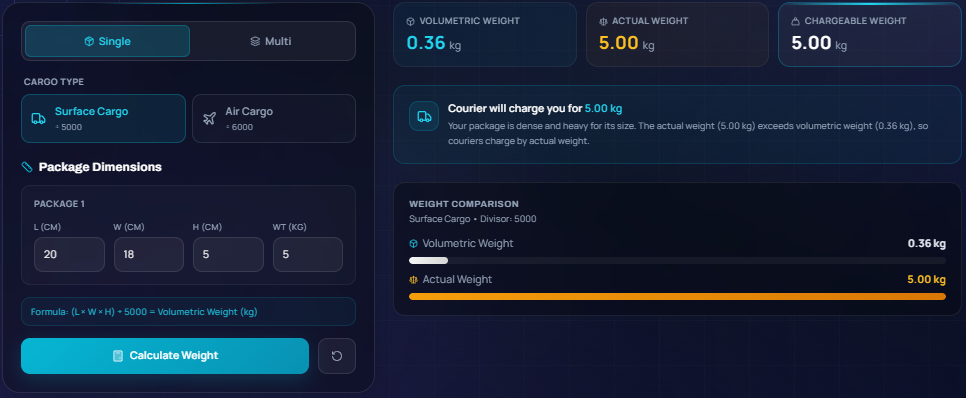
What is Volumetric Weight? (And Why Do Couriers Care?)
To understand why your shipping bill looks the way it does, we first need to look at the battle of volumetric weight vs actual weight.
-
Actual Weight (Dead Weight): This is exactly what it sounds like. It’s the reading you get when you put your boxed product on a weighing scale. If it weighs 2 kilograms, its dead weight is 2kg.
-
Volumetric Weight (Dimensional Weight): This is a theoretical weight calculated based on the size of your package. It measures the amount of space your box takes up in a delivery truck or an airplane cargo hold.
Why Couriers Use Dimensional Pricing
Imagine a logistics company loading a cargo plane. On one side, they have 100 boxes of dense iron dumbbells. On the other side, they have 100 giant boxes filled with lightweight cotton pillows.
The plane will run out of physical space long before it hits its maximum weight limit because of those giant pillow boxes. If the courier only charged by actual dead weight, they would lose money flying a plane full of "air." To solve this, the logistics industry introduced the dimensional weight calculator. They calculate a weight based on the volume of the box, ensuring they are fairly compensated for the space it occupies.
Chargeable Weight in Logistics: The Golden Rule
So, when the invoice arrives, which weight do you actually pay for? Logistics partners use a simple rule known as Chargeable Weight.
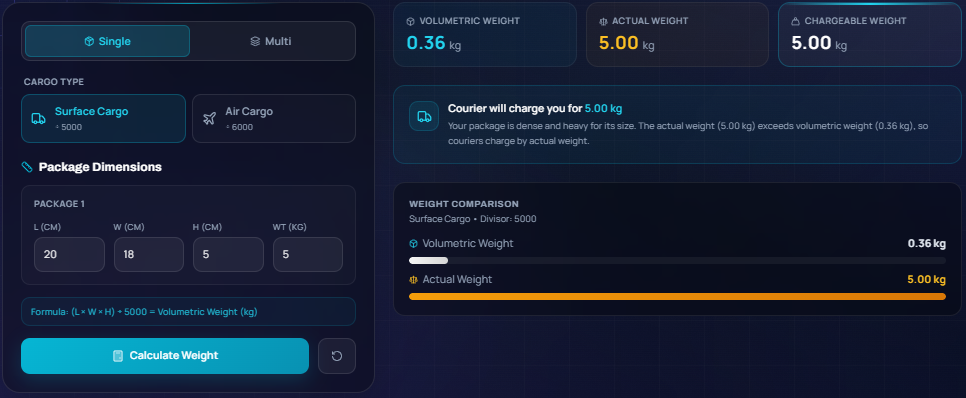
The courier will always charge you for the higher of the two: the Actual Weight OR the Volumetric Weight. If you are shipping a small, heavy item, you will likely pay for the actual weight. But if you are shipping a light item in a big box, volumetric weight will kick in, and your shipping costs will spike.
How to Calculate Volumetric Weight: The Formula
The courier volumetric weight formula is standardized across most of the world, though the "divisor" can change based on the carrier and the mode of transport.
Here is the standard formula: Volumetric Weight = (Length × Width × Height) / Divisor
(Note: Dimensions are typically measured in centimeters).
Understanding the Divisor (Divisor 5000 vs Others)
The divisor is a number set by the shipping company that represents the density of an average package.
-
Divisor 5000 Volumetric Weight: This is the most common standard used by major logistics aggregators and courier partners in India and globally for domestic shipments.
-
Surface Cargo vs Air Cargo Weight: It is important to check with your partner, as the divisor can shift depending on how the item travels. While air cargo strictly uses 5000 (or sometimes 4000 for international express), surface cargo (trucking) might use a larger divisor like 4500 or 5000, making ground shipping slightly more forgiving for larger boxes.
Step-by-Step Example: Seeing the Formula in Action
Let’s put this into perspective with a real-world example.
Imagine you run an ecommerce store selling kitchenware, and a customer has just ordered one of your premium insulated lunch boxes.
-
The actual dead weight of the lunch box, including the packaging, is 600 grams (0.6 kg).
-
To keep it safe, you place it in a sturdy cardboard box with dimensions of 25 cm (Length) x 20 cm (Width) x 15 cm (Height).
Now, let's run this through our ecommerce shipping weight calculator formula using the standard 5000 divisor:
-
Multiply the dimensions: 25 × 20 × 15 = 7,500 cubic centimeters.
-
Divide by the standard divisor: 7,500 ÷ 5000 = 1.5 kg.
The Verdict: Even though your lunch box only weighs 0.6 kg, its volumetric weight is 1.5 kg. Because the courier charges the higher of the two, your chargeable weight is 1.5 kg.
If your shipping tier jumps in 500g increments, you just paid for two higher shipping slabs unnecessarily because of the box size! This is exactly why a shipping weight calculator India (or your local region) should be your best friend during the product packaging phase.
5 Proven Strategies to Reduce Courier Shipping Costs
Now that you understand the math, how do you fix it? Here are actionable ways to reduce your chargeable weight and keep your money.
1. Optimize Packaging Dimensions for Shipping
"Shipping air" is the biggest mistake new sellers make. If your box has two inches of empty space on every side of your product, you are literally paying to ship bubble wrap and oxygen. Audit your product catalog. Can that item fit snugly into a box that is just 2cm smaller in every direction? A minor reduction in box size can completely change the volumetric calculation and drop your shipment into a cheaper weight slab.
2. Ditch the "One-Size-Fits-All" Box Approach
Many small business owners buy one standard medium-sized box in bulk to save on packaging costs. However, placing small items into a medium box triggers high volumetric fees that far outweigh the money saved on bulk cardboard. Invest in 3 to 4 different box sizes that closely match your fastest-moving SKUs.
3. Switch to Poly Mailers for Non-Fragile Items
If you sell apparel, soft goods, or items already packed in durable retail boxes, get rid of the corrugated outer box altogether. Poly mailers contour tightly to the shape of the product, drastically dropping the (L x W x H) dimensions. This is one of the fastest ways to force the courier to charge you strictly by actual dead weight.
4. Negotiate Your Volumetric Divisor
If you are doing high volume, everything is negotiable. While standard accounts use a 5000 divisor, high-volume shippers can often negotiate a divisor of 4500 or even lower with their 3PL (Third-Party Logistics) provider. A higher divisor means a lower volumetric weight outcome. [Internal Link Placeholder: Check out our guide on negotiating with 3PL providers]
5. Audit Your Courier Bills Regularly
Automated courier scanners aren't perfect. Sometimes, a box bulges slightly on the conveyor belt, and the laser scanner registers a higher dimension. Use an internal dimensional weight calculator tool to track what the chargeable weight should have been, and raise disputes with your shipping aggregator if you notice consistent overcharging.
Platform-Specific Nuances: Amazon, Flipkart, and Shopify
When you fulfill orders yourself (Shopify, WooCommerce), you have total control over the courier you choose and the packaging you use. But when you sell on major marketplaces, the rules become stricter:
-
Amazon Easy Ship / FBA: Amazon has strict dimension guidelines and tier fees. If your product is slightly too large, it bumps into an "oversize" tier, skyrocketing your fulfillment fees. Always calculate volumetric weight before deciding on your final retail product packaging.
-
Flipkart / Myntra: Similar to Amazon, marketplace aggregators track volumetric weight aggressively. Make sure your listings accurately reflect the packed dimensions so you aren't hit with unexpected seller fee deductions at the end of the month.
Frequently Asked Questions (FAQ)
What is a dimensional weight calculator? A dimensional weight calculator is a tool or formula used by logistics companies to estimate the weight of a package based on its length, width, and height. It ensures couriers are compensated fairly for large but lightweight packages that take up valuable truck space.
How do I calculate the courier volumetric weight formula? Multiply the package's exterior Length, Width, and Height (in centimeters), and then divide that total by the courier's specified divisor (usually 5000 for domestic shipments). The resulting number is your volumetric weight in kilograms.
What is the difference between dead weight vs volumetric weight? Dead weight (or actual weight) is how heavy the package is on a physical weighing scale. Volumetric weight is a calculated metric based on the physical dimensions (size) of the box.
What does chargeable weight in logistics mean? Chargeable weight is the final number the courier uses to calculate your shipping fee. Logistics companies compare the package's actual dead weight and its calculated volumetric weight, and they always bill you for whichever number is higher.
Why is my shipping bill higher than my product weight? You are likely being billed on volumetric weight because your packaging is too large for the item inside. To fix this, reduce your box size or switch to form-fitting packaging like poly mailers to eliminate "empty space" in your shipments.
Conclusion
Understanding how to use a volumetric weight calculator is a non-negotiable skill for any serious ecommerce seller. Every centimeter of cardboard you use directly impacts your bottom line. By mastering the volumetric weight formula, understanding the standard divisor 5000 volumetric weight rule, and actively choosing the right packaging dimensions for shipping, you can instantly trim down bloated courier bills.
Don't let logistics eat your hard-earned profits. Take an hour this week to measure your top three best-selling products. Calculate their volumetric weight versus actual weight. You might just find out that trimming down your box size is the easiest money you'll make all month!
Tags
Related Articles
![How to Calculate Profit Margin for Amazon, Flipkart & Meesho Sellers [Free Tool]](https://res.cloudinary.com/dirxmlqvw/image/upload/f_auto,q_auto,w_1080,c_limit/v1782261330/blog-images/apanivjsqzhts0qndw2v.png)
How to Calculate Profit Margin for Amazon, Flipkart & Meesho Sellers [Free Tool]
Selling products online in India is an incredibly exciting journey. Whether you are scaling a househ...

Free Image Resizer for Amazon, Flipkart & Meesho: Get Your Listings Approved in Seconds
If you sell products online, you already know the sinking feeling. You’ve spent hours writing ...

Product Description Best Practices to Boost Conversions & SEO
Most sellers focus on images and pricing, but ignore one thing that quietly drives results product d...