![How to Calculate Profit Margin for Amazon, Flipkart & Meesho Sellers [Free Tool]](https://res.cloudinary.com/dirxmlqvw/image/upload/f_auto,q_auto,w_2048,c_limit/v1782261330/blog-images/apanivjsqzhts0qndw2v.png)
Selling products online in India is an incredibly exciting journey. Whether you are scaling a household brand or launching your very first side-hustle, watching the orders roll in brings an undeniable rush. However, many e-commerce entrepreneurs eventually run into a painful realization: high order volume does not automatically mean high profit.
Between platform commissions, complex logistics costs, packaging expenses, and the dreaded customer returns, your actual take-home revenue can shrink surprisingly fast. If you are relying on basic spreadsheets or guesswork to track your money, you might accidentally be selling at a loss.
To run a sustainable business, you need an accurate product profit calculator India that accounts for local marketplace structures. In this ultimate guide, we will break down the exact formulas required to protect your bottom line. Best of all, we will introduce you to a free, built-in ecommerce profit calculator designed to save you hours of manual math.
The Hard Truth About Selling Price vs Profit Margin
Many new entrepreneurs fall into the trap of focusing entirely on top-line revenue. They assume that if they buy a product for ₹80 and sell it for ₹299, they have pocketed a clean profit of ₹219. Unfortunately, the reality of Indian marketplaces is far more complex.
When analyzing selling price vs profit margin, you must account for a web of hidden deductions. Your gross selling price is just the starting point; what matters most is your net profit margin.
Let's take a look at how an automated online selling profit calculator simplifies this chaos, as illustrated in the dashboard view from image:
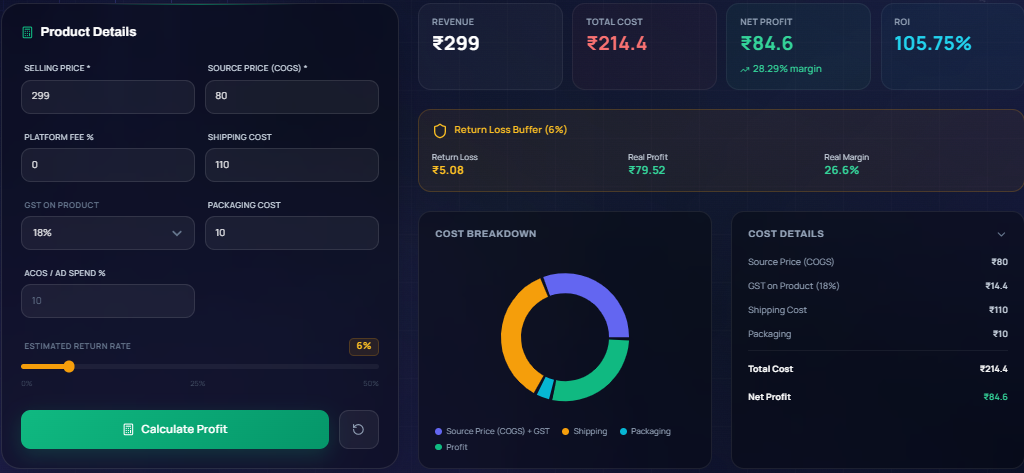
As shown in image, even with a healthy selling price of ₹299 against a source cost of ₹80, your real-world net profit depends heavily on shipping, packaging, and regulatory deductions. Without a reliable profit margin calculator ecommerce framework, tracking these variables consistently across thousands of listings is nearly impossible.
The Ultimate Ecommerce Cost Breakdown Tool: What Eats Your Margin?
To know how to calculate profit in ecommerce businesses, you first need to identify every single hidden fee that chips away at your revenue. Let’s look at a comprehensive ecommerce cost breakdown tool checklist that every Indian marketplace seller must track.
1. Source Price (COGS)
Your Cost of Goods Sold (COGS) is the baseline amount you pay to manufacture or source a single unit of your item from a supplier or wholesaler. A dedicated COGS calculator for sellers should also factor in the inbound freight costs required to bring those items to your warehouse.
2. Platform Fees & Referral Commissions
Every marketplace charges you for access to their customer base:
-
Amazon & Flipkart: They utilize a tiered system consisting of referral fees (a percentage of the selling price based on the product category), fixed closing fees, and technology costs.
-
Meesho: Famous for its zero-commission model, Meesho keeps this specific cost minimal, though sellers must still factor in logistics and promotional boosts.
Using an integrated Amazon seller profit calculator or Flipkart seller profit calculator ensures you don't overlook these shifting category-specific percentages.
3. Shipping and Logistics Costs
Shipping is often the largest variable expense for an e-commerce brand. Depending on whether you use fulfillment services like Amazon FBA, Flipkart Assured, or third-party couriers, shipping costs vary drastically by weight and distance zone (Local, Regional, or National). Ensuring an accurate net profit after shipping cost calculation prevents unexpected logistics bills from wiping out your gains.
4. Goods and Services Tax (GST)
Unlike normal retail, marketplace platforms calculate GST on multiple fronts. You must account for the GST on the actual item sold (typically 5%, 12%, or 18%) alongside the input tax credit (ITC) you can claim back on platform fees and courier bills. Accurate GST profit calculation is essential to avoid running into cash flow trouble when taxes are due.
5. Packaging Costs
From bubble wrap and customized corrugated boxes to flyers and polybags, your packaging cost calculator column needs to explicitly track these expenses. Even a minor expense of ₹5 to ₹10 per order can add up to thousands of rupees over a month.
6. Marketing and Ad Spend (ACOS)
With intense competition across all major platforms, organic visibility is rarely enough. Running sponsored ads means tracking your Advertising Cost of Sales (ACOS). If your ad spend consumes 10% to 20% of your selling price, that must be factored directly into your product-level unit economics.
The Silent Margin Killer: Return Loss Buffer Ecommerce
If there is one thing that keeps Indian e-commerce sellers awake at night, it is RTO (Return to Origin) and customer returns. Across Indian marketplaces, return rates typically hover anywhere between 15% to 40%, particularly for Cash on Delivery (COD) orders.
When a product is returned, you don't just lose out on the sale; you are often forced to bear two-way shipping fees and potential inventory damages. This is where a dedicated return loss buffer ecommerce calculation becomes vital.
Pro Tip: Never calculate profits based on a perfect 100% delivery rate. Always factor in a conservative return rate buffer (e.g., 5% to 15%) into your unit pricing models to absorb the logistical cost of returned products without eating into your core profits.
Step-by-Step: How to Calculate Profit in Ecommerce Manually
For those who want to understand the exact math driving our ROI calculator for online sellers, here are the core financial formulas used behind the scenes.
Step 1: Calculate Total Unit Cost
Step 2: Calculate Net Profit
Step 3: Calculate Net Profit Margin Percentage
Step 4: Calculate Return on Investment (ROI)
Real-World Case Study: Analyzing a ₹299 Listing
Let’s contextualize this using the exact mathematical breakdown presented in the interactive calculator from image_5dd212.jpg. Imagine you are selling a product with the following attributes:
| Expense Component | Value / Cost |
| Selling Price | ₹299 |
| Source Price (COGS) | ₹80 |
| Platform Fee % | 0% (e.g., a promotional Meesho listing) |
| Shipping Cost | ₹110 |
| GST Rate on Product | 18% (Amounting to ₹14.4) |
| Packaging Cost | ₹10 |
| ACOS / Ad Spend | 10% |
| Estimated Return Rate | 6% |
The Math in Action:
-
Total Direct Cost: Combining your ₹80 source cost, ₹14.4 GST, ₹110 shipping, and ₹10 packaging results in a Total Cost of ₹214.4.
-
Initial Net Profit: Subtracting ₹214.4 from your ₹299 selling price yields an immediate Net Profit of ₹84.6, reflecting a 28.29% profit margin.
-
The ROI Metric: Calculated against your raw sourcing price of ₹80, this product pulls a stellar ROI of 105.75%!
-
Factoring the Return Buffer: When a 6% return rate risk is introduced, the system deducts a ₹5.08 Return Loss Buffer, modifying your Real Profit to ₹79.52 and leaving you with a highly sustainable Real Margin of 26.6%.
This proves why using a structured Meesho profit calculator or broader D2C profit margin tool is so eye-opening. It transforms a guessing game into predictable, hard data.
Introducing Our Free Product Profit Calculator India
Why deal with complex formulas and messy spreadsheets when you can automate your unit economics? We built a free, interactive tool specifically for Indian online business owners, accountants, and marketplace sellers.
Whether you need a quick Amazon seller profit calculator or a dedicated Flipkart seller profit calculator, this tool processes your inputs instantly. Simply enter your selling price, sourcing cost, shipping fees, and applicable GST rate to visualize your real profits via a clean, interactive pie chart dashboard.
Using an automated solution protects your business from costly clerical mistakes, ensures your ad campaigns stay profitable, and helps you pick winning items before risking capital. Check out our comprehensive guide on [link to related post about e-commerce inventory management] to discover how to pair healthy profit margins with smart inventory tracking. For official insights into compliance regulations and e-commerce tax frameworks, you can also consult the official guidelines on the Ministry of Consumer Affairs India website.
Frequently Asked Questions (FAQ)
What is a good profit margin for online sellers in India?
For most marketplace and D2C sellers in India, a healthy net profit margin ranges between 15% to 25% after factoring in all platform commissions, shipping, packaging, and advertising costs.
Why do my Amazon and Flipkart settlements not match my calculations?
Settlement mismatches usually happen because sellers forget to account for category-specific closing fees, variable weight-handling charges, or customer return penalties. Utilizing a dedicated ecommerce profit calculator regularly helps align your pricing closer to actual platform payouts.
How does the Return Loss Buffer protect my business?
A return loss buffer dynamically sets aside a small financial cushion per order based on your historical return rates. This ensures that when an inevitable RTO or customer return happens, the lost courier fees don't completely derail your business's weekly cash flow.
Conclusion: Take Control of Your Financial Bottom Line
At the end of the day, scaling a successful e-commerce business isn't about who generates the most top-line revenue—it's about who keeps the most profit. By keeping close tabs on your COGS, platform fees, GST obligations, and return rates, you place your store far ahead of the competition.
Don't let hidden deductions quietly erode your hard work. Bookmark our free online selling profit calculator, run your product listings through it before sourcing new stock, and build a highly profitable business backed by real data.
Ready to find your most profitable product mix? Use our free calculator tool today and make guesswork a thing of the past!
Tags
Related Articles

Free Image Resizer for Amazon, Flipkart & Meesho: Get Your Listings Approved in Seconds
If you sell products online, you already know the sinking feeling. You’ve spent hours writing ...

Volumetric Weight Calculator for Ecommerce Sellers: How to Calculate Shipping Weight & Save on Courier Costs
Ever opened your monthly courier invoice, scanned the total, and let out a heavy sigh? You weighed y...

Product Description Best Practices to Boost Conversions & SEO
Most sellers focus on images and pricing, but ignore one thing that quietly drives results product d...